Confirm the legal commissioning entity. The party that introduces the work is not necessarily the party that pays.
Notice
This advisory is drawn from the 2021 library music record held on this site. It does not establish that the same sequence occurred in any other project, and it makes no determination of legal responsibility, intent or individual fault for the conduct recorded at the time.
Every 2021 item referenced below is recorded as a summary of a claimant-side notice or of a reviewed email thread. None of it is a finding of fact. Originals, private contact data and artist identities are withheld.
What the 2021 record shows
This advisory is specific because the order of events is on the record. Work advanced before terms were concluded, a stop instruction arrived after that work was done, and the treatment of costs became a question afterwards.
| Date | Recorded content |
|---|---|
| 2020/12/19 | VALSE Inc. is said to have asked the reporting side whether it could take on a library music production and management project under consideration by Nichion Inc. |
| 2021/03/19 | A project meeting is said to have covered concept, track count, an artist budget outline and schedule, with candidates requested by the end of March. |
| 2021/04/05 | The reporting side reported that project tracks had been uploaded and asked for budget confirmation, while Nichion Inc. instructed that work stop until the contract and formal order were in place. |
| 2021/04/06 | VALSE Inc. acknowledged that its own request had caused the steps to run out of order, and stated that it wished production to continue although no contract had yet been concluded. |
| 2021/04/09 | Nichion Inc. sent a copyright contract template and indicated that a master rights consent form would follow. |
| 2021/04/19 | Before a formal order, a three-document sequence was indicated: copyright contract confirmation, master rights consent, and a draft coordination and direction contract. |
| 2021/04/24 | Writer confirmation work was acknowledged as having been carried out, formal work was said to begin only after the contract and memorandum were concluded, and a coordination fee of 200,000 yen plus tax was proposed for the album. |
| 2021/04/26 | It was acknowledged that the earlier coordination and direction fee outline had not been conveyed accurately internally, and that work already performed would be paid for. The acknowledged work was categorised as selection of 20 writers, checking the status of copyright and publishing contracts, coordination of demo production, and production costs for 10 demos, with the question raised whether these fell inside a 1,000,000 yen plus tax coordination fee. |
| 2021/05/24 | A claimant-side notice to Nichion Inc. states that around 20 tracks had been ordered and around 17 delivered before the stop instruction, and claims 2,954,197 yen in total including 754,197 yen in artist ordering costs. The amount is recorded as disputed and not adjudicated. |
Three structures can be read from this sequence. Deliverables were moving before the paperwork was in place. The stop instruction arrived after the work. The scope of costs became a question after the fact. The advisory below addresses those three.
Which duties the same pattern would engage today
The Act on Optimization of Transactions with Specified Entrusted Business Operators cannot be applied to the 2021 sequence. It came into force on 1 November 2024 and is not a basis for judging earlier conduct. The table below shows which current duties would be engaged if the same order of events occurred today. It does not state that the conduct recorded at the time was a violation.
| Recorded structure | Duty engaged under current law | Provision |
|---|---|---|
| Work advances while terms remain unstated in writing | Duty to state trading terms. After commissioning, the work content, fee, payment due date and other required items must be stated immediately, in writing or by an equivalent electronic record | Article 3(1) |
| No payment due date set; no payment after receipt | Payment due date. The fee must be set within 60 days of receipt and as short a period as practicable, and must actually be paid by that date | Article 4, including Article 4(5) |
| Unilateral stop after work has begun; termination without settlement | Prohibited conduct for continuing commissions, including refusal to receive, fee reduction, return of deliverables and unjustified rework | Article 5(1) |
| Work performed without payment for the client's benefit | Prohibition on unjustified requests for economic benefit | Article 5(2)(i) |
| Fee set far below the normal rate for the same work | Prohibition on buying at an unreasonably low price, where the fee is set unilaterally without sufficient consultation | Article 5(1)(iv) |
This is a mapping of patterns. Whether a specific case falls under a specific duty depends on the facts and the contract type, and is a matter for a lawyer or the responsible authority.
The framework is in active operation
The mapping above is not theoretical. Since the Act came into force the Japan Fair Trade Commission has carried out sector-focused reviews and published guidance and recommendations. Those are separate matters unconnected to this record and do not involve the parties named here. The list of individual actions and the provisions applied is kept on a separate teaching note that contains no proper names.
This page is the place for the 2021 record itself. Findings against other businesses are not listed here, and the two are not intended to be read in the same context.
Pre-engagement checklist
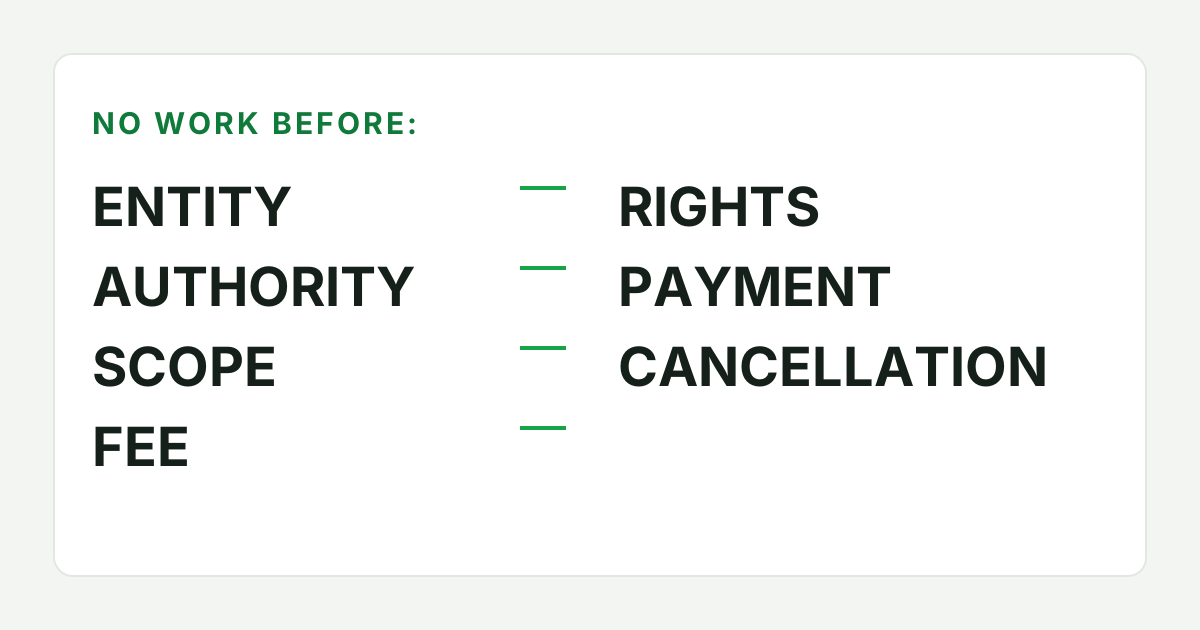
These are the items to settle before starting. Moving deliverables while any of them is still open puts you in the same position as the 2021 record.
Confirm the authorised decision-maker. Your contact may not hold final approval.
Obtain a written statement of work. A verbal request lets the scope move later.
Agree the fee before songwriter outreach begins. Once you make contact, commitments to third parties exist.
Set the external writer budget separately. Settle in advance whether it sits inside the coordination fee.
Confirm overseas remittance costs and tax treatment. Avoid advancing out-of-pocket costs.
Set a cancellation payment or kill fee. It is what you settle against when a stop instruction arrives.
Prohibit use of demos after cancellation unless separately licensed.
Condition rights transfer on completion of full payment.
Ask for written confirmation of instructions given by phone or in meetings.
Name who issues the contract and the purchase order. In preparation is not a signal to begin.
Provide for deletion or return of unused demos and confidential material.
Transaction risk table
| Issue | Transaction risk | Defence before starting |
|---|---|---|
| Commissioning entity | The introducer and the payer may differ | Written confirmation of the legal entity |
| Authority | The contact may not hold final approval | Confirm the authorised signatory |
| Scope | Work may expand informally | Signed statement of work |
| Fee | Fee discussion may follow the start of work | Fee approval in writing |
| External writers | Commitments to third parties may arise | Approved writer budget |
| Rights | Rights clearance may start early | Fix rights terms before outreach |
| Cancellation | Work may end without settlement | Kill fee |
| Demo use | Unused demos may remain accessible | Deletion and non-use clause |
Where to get help
Freelance Trouble 110-ban is commissioned by the Ministry of Health, Labour and Welfare and operated by the Daini Tokyo Bar Association. It covers disputes between freelancers and commissioning businesses, including unpaid fees, missing contracts, repeated rework and harassment. Consultation is free and can be anonymous, and it extends to a settlement mediation procedure.
Reports may also be made to the Japan Fair Trade Commission and the Small and Medium Enterprise Agency. The guidance and recommendations above came out of concentrated reviews informed by such reports. Administrative routes do not replace a civil claim: recovery of an unpaid fee remains a separate civil matter, and what supports it is the dated written record built during the engagement.
Privacy and source protection
The underlying correspondence is not published in full. Personal data, third-party information and communication-identifying details are withheld. The public summary is limited to what is considered necessary to explain the recorded transaction structure.