Public Research Records · Security & governance
NEC incident update: Osaka Metropolitan University, about 170,000 people and shared-cloud risk
On 13 November, Osaka Metropolitan University reported that information leaked from an NEC-managed cloud included personal information concerning about 170,000 people, with sensitive information concerning about 1,400 within that group. We compare the university’s sixth notice and annexes with NEC’s announcement, separating reported impact from general risk analysis.
Related reporting: MBS NEWS
Japanese-language reporting. Counts and access paths are grounded in the university’s sixth notice and annexes. Open on YouTube
MBS NEWS footage previously embedded here was private when checked on 15 November 2026. Its reference is retained as a historical record; it is no longer advertised as a playable video in structured data.

Key points from the public sources
- Whose information was involved, and how many people?
- The 13 November notice concerns Osaka Metropolitan University information leaked from NEC-managed cloud storage, involving about 170,000 people. Osaka University is a different university and reporting scope. [S1]
- Are the roughly 1,400 people additional?
- They are within the 170,000. Sensitive-category counts must not be added together because overlap is not specified. [S2]
- Is leakage from university systems also confirmed?
- The sixth notice says no clear fact of personal-data leakage from university systems has yet been established, while the possibility cannot be excluded. [S1]
- Is impact on a particular medical AI service confirmed?
- The cited notices do not establish impact on a particular medical AI service or shared maintenance paths or storage infrastructure. Contracts, access and storage must be checked separately for each service. [S1] [S4] [S5]
What the university and NEC report
A more specific account of the impact
The university says NEC provided an additional report on 12 November. Names, IDs, email addresses and birth dates concerned about 170,000 people. Within that group, about 1,400 had sensitive information such as bank account numbers, health information, passport images or passport numbers exposed. [S1]
Sensitive categories and how to read the counts
Annex 1 gives approximately 20 people for bank account numbers, 200 for health information, 200 for passport images and 1,000 for passport numbers. The figures are approximate and category overlap is not specified. The 1,400 are a subset of the 170,000; category figures must not be added to invent another total. [S2]
Credentials and access to university systems
The university reports unauthorised access using legitimate credentials, including administrator accounts, shortly after information was taken from an external contractor’s endpoint and NEC-managed cloud. The account of the route and attribution to the same attacker is the university’s published investigative assessment. [S1]
Migration data from fiscal 2021 remained stored
The university says much of the sensitive information came from a fiscal-2021 system migration and remained in NEC-managed cloud storage after the work ended. The university describes prolonged retention and storage accessible to many involved parties as serious problems. [S1]
Exfiltration from university systems remains a separate question
The sixth notice says no clear fact of personal-data leakage from university systems has yet been confirmed, while the possibility cannot be ruled out. Confirmed cloud leakage is distinct from possible university-system exfiltration. Earlier figures of roughly 130,000 records must not be added to the 170,000 people. [S1]
Relation to the 2019 AI emergency consultation service
The 2019 Saitama–NEC announcement records separate medical-supervision and technical-provider roles. The incident notices do not establish shared contractors, cloud storage, credentials or consultation data with that service. They support prioritising checks on outsourcing and retention, but do not establish impact on a different service. [S5]
Approximate counts by sensitive category
The 1,400 are within the 170,000. The categories below must not be added together.
Map of information paths and evidence status
Drag or select a node to see its source. Lines represent reported paths and the university’s assessment.
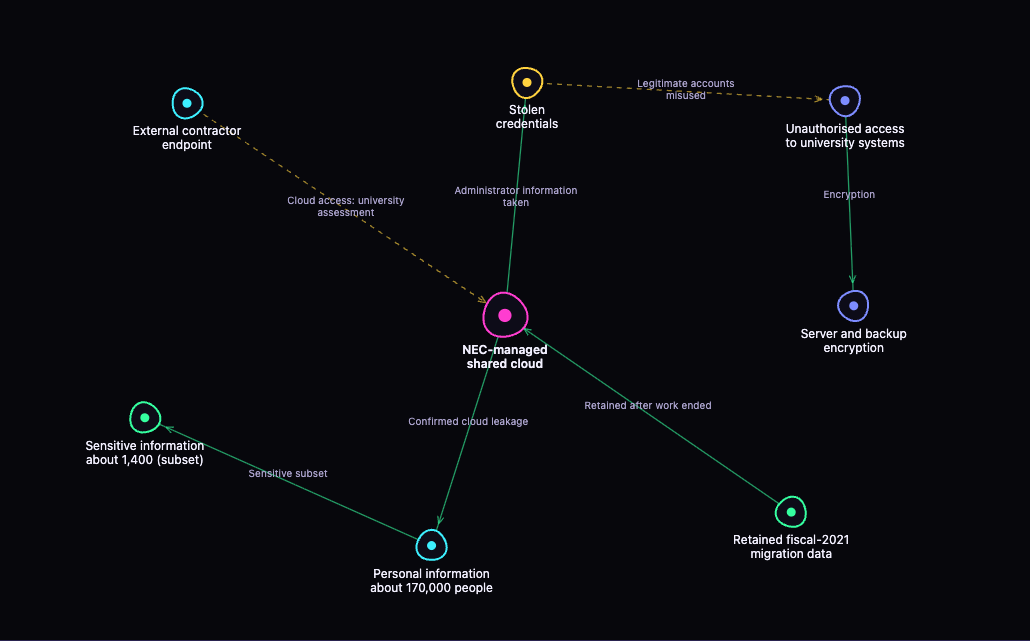
| Map of information paths and evidence status | What the university and NEC report | Source |
|---|---|---|
| External contractor · endpoint → NEC-managed · shared cloud | Cloud access: university assessment | S3 |
| NEC-managed · shared cloud → Stolen · credentials | Administrator information taken | S3 |
| Stolen · credentials → Unauthorised access · to university systems | Legitimate accounts misused | S3 |
| Unauthorised access · to university systems → Server and backup · encryption | Encryption | S3 |
| Retained fiscal-2021 · migration data → NEC-managed · shared cloud | Retained after work ended | S1 |
| NEC-managed · shared cloud → Personal information · about 170,000 people | Confirmed cloud leakage | S1 |
| Personal information · about 170,000 people → Sensitive information · about 1,400 (subset) | Sensitive subset | S1 |
| Stolen · credentials → Administrator accounts | Includes administrator credentials | S1 |
| Sensitive information · about 1,400 (subset) → Bank account numbers · About 20 people | Approximate category | S2 |
| Sensitive information · about 1,400 (subset) → Health information · About 200 people | Approximate category | S2 |
| Sensitive information · about 1,400 (subset) → Passport images · About 200 people | Approximate category | S2 |
| Sensitive information · about 1,400 (subset) → Passport numbers · About 1,000 people | Approximate category | S2 |
| Unauthorised access · to university systems → University-system exfiltration · Not clearly confirmed | Exfiltration unconfirmed | S1 |
| NEC-managed · shared cloud → Storage accessible to · many involved parties | Shared-access scope | S1 |
| NEC-managed · shared cloud → 12 November · Additional NEC report | Additional report | S1 |
| 12 November · Additional NEC report → 13 November · University sixth notice | Published as sixth notice | S1 |
| Personal information · about 170,000 people → Identification of people · and categories continues | Detailed investigation continues | S1 |
Analysis: the management questions are more concrete
Editorial analysis
Maintenance privileges and credentials
Reported misuse of legitimate accounts makes least privilege, credential separation and revocation, audit logs and managed maintenance endpoints priorities for review. This does not establish a deficiency in a particular service.
Retention and deletion after migration
Review residual copies, sharing, retention deadlines and deletion evidence when migration work ends. Contractual duties and responsibility require the relevant individual records.
Sensitive-data separation and impact assessment
Health and travel-document information make classification, project-level separation, access scope, identification of affected people and notification concrete review topics.
Applying the lessons to medical AI
Check each service’s contractors, maintenance access, storage, inputs, logs and backups. This incident alone does not measure an increase in AI error rates or clinical danger.
Additional findings are distinct from further spread
The university says investigation to identify individuals and information categories continues at NEC. Additional affected people or data categories may be identified; this is not confirmation that new harm is spreading to other customers or services.
Evidence scope
Reported facts, the university’s investigative assessment and our general management analysis are separated. A common supplier does not by itself establish shared access paths or storage infrastructure between services.